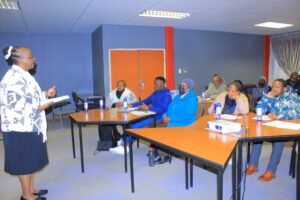
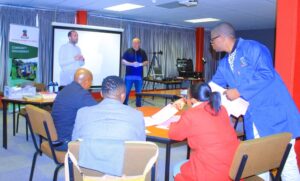
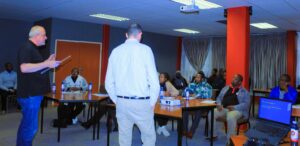
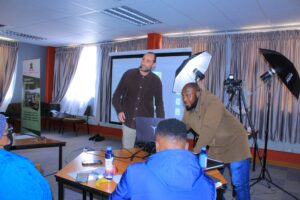
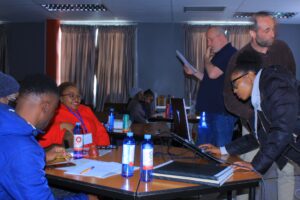
The National University of Lesotho (NUL) Library hosted a three day Digitisation Workshop, taking place from 5 to 7 May 2026 held at the Thomas Mofolo Library at Roma campus.
The workshop was organized as part of a national initiative to strengthen digitization, conservation, and preservation capacity across Lesotho’s memory and knowledge institutions. The event fell under the umbrella of the National Digitization Framework Development Project, which was funded by the British High Commission in Lesotho.
Having launched in February 2026, the project was coordinated under the leadership of the NUL Library. It successfully united a broad range of institutions involved in creating, managing, and preserving documentary and cultural heritage—including the National University of Lesotho, Morija Museum and Archives, the National Library of Lesotho, Paray School of Nursing, Scott College of Nursing, Lerotholi Polytechnic, Lesotho College of Education, and the Royal Archives.
The digitization project aims to establish a coherent, collaborative, and sustainable national framework for digitization, enhancing information access while safeguarding Lesotho’s heritage resources for future generations.
Since its inception, the project has been implemented through a carefully sequenced series of capacity building and consultative activities. An early milestone was a study visit to the United Kingdom, undertaken by representatives from NUL, Morija Museum and Archives, and the National Library of Lesotho. The visit provided exposure to international best practices in digitisation, digital preservation, and cross institutional collaboration, helping to shape local thinking around a national digitisation strategy.
Building on insights from the study visit, the Digitisation Framework Workshop was convened in March 2026 at Botleng Guest House. Spearheaded by the NUL Library, the workshop provided a platform for stakeholders from different institutions to deliberate on how a national digitisation framework for Lesotho should be structured, including its guiding principles, scope, and institutional responsibilities.
This was followed by a Conservation and Preservation Workshop, which highlighted the importance of stabilising and protecting physical collections as a foundation for sustainable digitisation. The workshop reinforced the understanding that digitisation is inseparable from sound conservation and preservation practices, particularly within institutions holding vulnerable or unique materials.
The Digitization Workshop hosted at NUL built directly upon these earlier strategic engagements.
Participants in the workshop were drawn from the same cohort that took part in the Conservation and Preservation Workshop, ensuring continuity, shared understanding, and cumulative learning throughout the project. They represented a diverse range of memory and educational institutions across the country, reflecting the project’s inclusive and national character.
The Digitization workshop was facilitated by experts from the British Library, whose extensive experience in digitisation and preservation supports both the technical and strategic dimensions of the discussions. Through presentations, facilitated dialogue, and hands on engagements, the facilitators guided participants on digitisation workflows, standards, quality assurance, metadata creation, file management, and digital preservation, while supporting contextualisation within the realities of Lesotho’s institutions.
Over the three days, the workshop sought to strengthen institutional readiness for digitisation and to equip participants with the practical skills and shared understanding required to support the implementation of the National Digitisation Framework. In this regard, the workshop played a critical role in translating policy and framework discussions into actionable institutional practice.
The Digitisation Workshop marked one of the final capacity building activities coordinated by the NUL Library under the project. It directly precedes the official launch of the National Digitisation Framework, scheduled for 8th May, 2026 at Avani Lesotho. The launch will mark the culmination of the project and formally introduce the framework as a national guiding instrument for coordinated digitisation efforts across Lesotho.
Through its leadership role, the NUL Library has been central to convening stakeholders, facilitating knowledge exchange, and driving momentum towards a shared national digitisation vision. The Digitisation Workshop at NUL stood as a key milestone in this journey, reinforcing collaboration among libraries, archives, museums, and educational institutions, and contributing to improved access to Lesotho’s documentary and cultural heritage in the digital age.