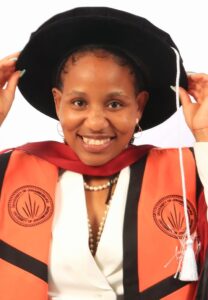
Have you ever been stuck in a long traffic in Maseru, Lesotho? Or maybe you’ve had to walk on a busy street because there’s no sidewalk? Well, Dr Retšepile Kalaoane, once a student at the National University of Lesotho (NUL), is shining a spotlight on this and similar problems in Maseru, Lesotho’s capital city! She is also making suggestions on what we can do to fix them.
Dr Kalaoane is working with a team of scientists from the University of Freestate and the University of Johannesburg. Her complex research work, which we simplify here, for your benefit, is published under the heading, “The Complex Web of Land Use Planning, Legislation and Urban Mobility in Maseru, Lesotho.”
It’s published in a respected international journal; Discover Sustainability.
In her study, she focused on Maseru’s Main North 1 Road.
This road is very important because it connects Maseru to towns like T.Y, Maputsoe, Hlotse and Butha-Buthe. But it’s also one of the busiest roads, and it has lots of problems.
First, there are too many cars.
Families are buying more cars like there is no tomorrow. The presence of low-cost mainly Japanese import cars is not helping. This means the roads are getting crowded, especially in the mornings when everyone is rushing to work or school.
The evenings are not any better…for the same reasons in reverse.
Then there are the sidewalks—or sometimes, there aren’t any!
Many places don’t have enough space for people to walk safely, so people end up walking on the road. That’s very dangerous because cars and mini-busses are also zipping by.
And when it rains? The road floods because the water doesn’t have anywhere to go. Drivers have to stop, and people can’t walk without getting wet or muddy.
Why does this happen?
Dr Kalaoane found out that a big reason for these problems is planning—or rather, the lack of it!
Many parts of Maseru weren’t planned properly. People built homes and shops without asking for permission or following rules. That the laws are too old and outdated is not helping either.
Lack of planning also meant that all the important places—like offices, schools, and shops—are in the middle of the city. That means thousands of people flock into the city centre every day, which causes traffic jams.
There’s also a challenge with street vendors. They sell things like fruits, vegetables, or clothes along the roads to make a living. While they help people buy things quicker, their stalls sometimes block the sidewalks and roads, making it harder for cars and people to move around.
So what can we do about it?
That’s the question Dr Kalaoane and her team set out to answer. Of course, it is a million-dollar question, so there are no easy fixes. It’s hard to fix a city that’s already exists.
While the fixes will need money, some will just mean being more creative in our thinking.
She says we need to make roads safer for everyone, especially people who walk or ride bicycles. Encouraging cycling is healthy and can reduce car use. That means building better sidewalks, crossings and bicycle tracks where possible.
She also thinks there should be more bus stops and places for people to park their cars away from the busy streets.
She suggests we should spread out important places so people don’t all have to go to the city centre. If schools, shops, and offices were closer to where people live, they wouldn’t need to drive so far every day.
Another idea is to use modern technology, like smart traffic lights that help cars move faster or apps that show people where they can park.
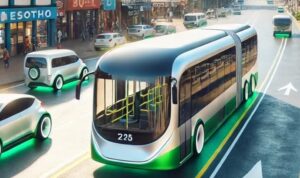
Dr Kalaoane also suggests introducing a Bus Rapid Transit (BRT) system. This system would provide faster and more reliable buses that connect different parts of the city. If people had a better option, they might use buses instead of relying so much on taxis or small cars. But it’s not just about reducing the number of taxis and 4+1 vehicles; the drivers and owners of these vehicles could be included as part-owners of the new system so they can also benefit.
She also says it’s important to start thinking about electric vehicles (EVs). Many countries are already planning to stop using petrol cars to help the environment. A good BRT system would work well with this change, making public transport modern, clean, and ready for the future.
There are many other suggestions which you will find in her report.
Fixing our roads isn’t just about avoiding traffic jams—it’s about helping people live better lives, she says. If roads are safe and easy to use, kids can get to school faster, parents can spend less time stuck in traffic, and everyone can feel safer while travelling.
When roads work well, she observes, they help the whole city. Shops get more customers, the city gets more tourists, and there are fewer accidents.
“When we work together, we can make our city better for everyone!” concludes the good Dr.