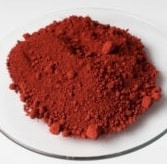
What if we told you the famous red ochre (letsoku) that our grandmothers trust so much for sun protection… might not actually protect us from the sun the way we think it does? Well, that’s exactly what a brilliant National University of Lesotho (NUL) student, Thethe Likhang, found! He put letsoku through modern scientific testing to answer a burning question:
Does letsoku REALLY protect our skin from harmful UV rays? Because; let’s be honest! The Lesotho sun is not the coldest in the world.
You’ll recall Thethe was the best graduating student just last year at NUL. He’s now working there under the Department of Mathematics and Computer Science. Well, it turns out he also played around with Letsoku before leaving school.
You know the deal: for generations, Basotho have used letsoku not only for beauty and cultural identity but also believing it protects our skin from the hot sun.
So it makes you look good AND keeps you safe?
Sounds perfect, or, as say they say, a win-win!
But Thethe wasn’t ready to just believe the hype. He said, “We had to test it scientifically!”
So he grabbed letsoku samples (the red kind rich in iron minerals) and took them to the lab for UV-Vis-NIR Spectroscopy, which basically shoots UV light at a material to see whether it absorbs or blocks harmful rays.
He tested two versions of the mixture, one heated at 60°C and another at 30°C, just to see if the temperature made a difference.
Spoiler alert: not really!
But why does this even matter?
Lesotho is one of the highest UV radiation zones in the world. Our UV Index can go up to 16 in summer, which is extremely dangerous! Even in winter, our UV levels are still high.
That means relying on something that might not work is risky.
So… What did the results show?
Thethe discovered that letsoku:
•Absorbs some UV-C (the worst type; but guess what? UV-C never reaches Earth anyway!)
•Absorbs a little bit of UV-B (the sunburn-causing one)
•Absorbs almost no UV-A, the one that actually reaches us the most and causes skin aging + long-term skin damage!
Meaning? Even if you’re painted head-to-toe like a traditional warrior, UV rays are still winning.
The conclusion was clear:
Letsoku alone does not give enough protection against harmful UV radiation.
Ouch. Generations of Basotho won’t like this plot twist.
But the research didn’t stop there…
Thethe even considered measuring SPF; the number we see on sunscreen bottles. But exposing volunteers to sunlight until they burn? Not exactly safe or ethical. Also, calculating SPF properly requires more advanced solar and spectral equipment than what was currently available.
So yes… this is Phase 1 of what could become something bigger.
So what’s next?
Thethe made a brilliant recommendation:
•Combine letsoku with proven UV filters like zinc oxide or titanium dioxide to create a super-sunscreen!
•Continue improving the formula scientifically
•Still keep cultural beauty, but add modern safety
Imagine a future where; Letsoku-based sunscreen is sold at MILCO. Then Basotho will proudly protect their skin using Lesotho-made cosmetics. Then, science will truly meet culture…beautifully!
That’s the dream.
And until then?
Please… don’t break up with letsoku entirely! It’s still amazing for Culture, Beauty and some minor protection. But pair it with shade, hats, proper sunscreen, and good timing outdoors.
Because the sun doesn’t play, especially in Lesotho.
Final Word from Thethe?
“We respect tradition; but now we also love evidence. Let’s improve what we already have, and innovate for our safety.”
That’s the power of (NUL) science.